

易飞迅
About Us
Highly Customized Solutions > Industry Solutions > Industry

Industry

Make Industrial Warehousing and Logistics Soar

I. Industry | Challenges Faced by the Industry

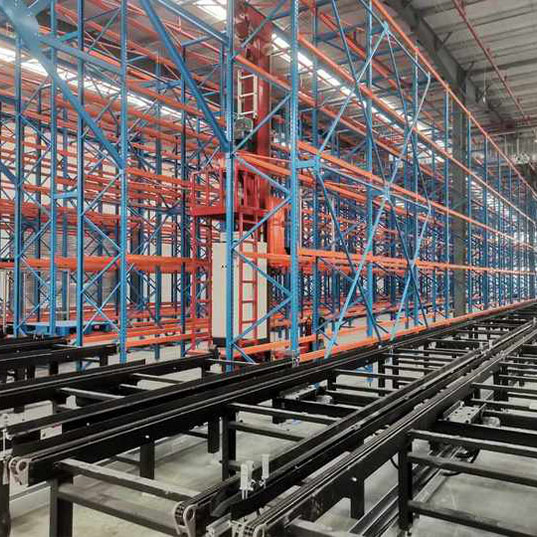
The accelerated improvement of productivity has led to a clearer division of labor in society. Industry 4.0 and the Industrial Internet have given rise to today's smart factories. The high level of digitalization and intelligence in front-end production operations is driving warehousing and logistics toward trends of small batches, multiple frequencies, and highly customized solutions. Coupled with the complexity and diversity of materials, high timeliness of operations, and requirements for high safety and high-precision storage and transportation, this continuously promotes the automation and intelligent upgrading of warehousing and logistics, while also providing more application scenarios for diversified and non-standard customized logistics technologies.

Industry

II. EFX | Scenario-Based Solution

  • Wheel Hub Industry

    Smart warehousing highly customized solutions

  • Alloy Materials

    Smart warehousing highly customized solutions

  • Automotive Electronics | Components

    Smart warehousing highly customized solutions

III. Successful Case | EFX Helps Jinfei Wheels Achieve a Dual-Benchmark Project

1. Timeline

1) Project Start: September 2022; 2) Delivery Date: October 2023

2. Project Background

Jinfei Holdings Group Co., Ltd. was founded in 1959 and is headquartered in Wucheng District, Jinhua City. Since 2000, it has been listed as a key enterprise supported by the Jinhua municipal government and has successively been awarded titles such as China's Top 500 Manufacturing Enterprises, China's Top 500 Private Manufacturing Enterprises, China's Top 100 Automotive Parts Enterprises, Leading Enterprise in China's Motorcycle Parts Industry, Leading Enterprise in China's Automotive Wheel Industry, Zhejiang Top 100 Manufacturing Enterprises, Zhejiang Industrial Leading Backbone Enterprise, Zhejiang Management System Certification Demonstration Enterprise, and Zhejiang Standard Innovation Enterprise.

The smart warehousing project of Jinfei Wheels is a pilot project created by the enterprise, intended to become a dual-benchmark project for both the wheel hub industry and the Jinhua region.

3. Solution

EFX highly customized smart warehousing system solution

1) Full automation from production lines to automated storage and retrieval systems; 2) Full information flow from production lines to outbound shipping.

4. System Equipment

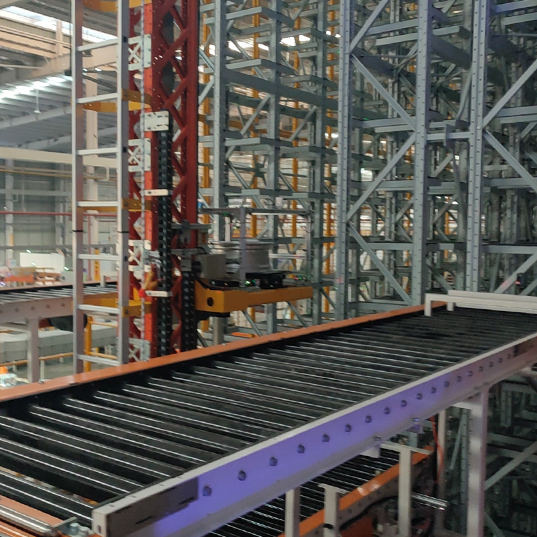
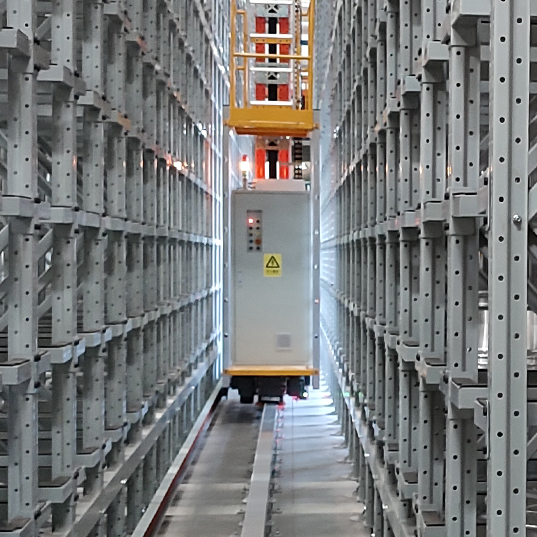
1) Automated storage and retrieval systems: two AS/RS for raw and semi-finished products, using six Miniload stacker cranes, each with a load capacity of 50 kg, a height of 11 m, and a single-machine efficiency of 100 items/hour (85% utilization rate);

2) Pre-warehouse conveying and sorting system, equipped with 200 m of tote conveying and sorting lines;

3) Software: Warehouse Management System (WMS).


IV. Challenges of the Jinfei Wheels Project Wheels Project

After fully understanding customer requirements, EFX identified two major challenges in this project due to the surface material and individual weight of wheel hub products.

Challenge 1: How to avoid scratches when the forks come into direct contact with the wheel hubs?

Challenge 2: How to ensure safety during high-speed conveying of wheel hub products?

During the planning and design of the project solution, in order to completely resolve issues of scratching and product ejection, EFX used Jinfei's wheel hub samples to conduct conveying and storage tests on its own factory conveyor lines. By simulating real scenarios and conducting extensive testing and data comparison, EFX mastered the motion trajectory and principles of wheel hub products in automated warehousing, thereby effectively resolving the issues.

V. How EFX Helped Jinfei Wheels Reduce Costs and Improve Efficiency

  • Improving contact surface materials and upgrading conventional fork materials to reduce cargo damage to zero!

    Before wheel hub products are put into storage, they are forked onto the conveyor line by forks. During this process, the forks come into direct contact with the wheel hubs and may cause minor scratches. The typical weight of wheel hubs ranges from 10 to 20 kg; the heavier the hub, the more severe the scratches caused by fork contact. Once scratched, the product becomes defective and must enter a rework process involving polishing, grinding, and repainting.

    Even a small scratch requiring reprocessing can significantly affect production schedules. To address this issue, EFX replaced the conventional hard contact materials on the forks with flexible materials wrapping the contact surfaces between the forks and wheel hubs, enabling damage-free contact and naturally reducing cargo damage to zero.

    How EFX Helped Jinfei Wheels Reduce Costs and Improve Efficiency
  • Increasing contact surface friction to ensure safe automated conveying and storage

    Each wheel hub weighs over ten kilograms, combined with a high conveying speed of 120 m/min, resulting in high gravitational acceleration during high-speed operation. Products may shift or shake multiple times during conveying. When conveyor lines transfer tracks, speed must be reduced to zero; the heavier the wheel hub, the greater the inertia, and there is even a risk of products being thrown off the track, further increasing cargo damage.

    After multiple simulation experiments and data analysis, EFX concluded that increasing the friction between the wheel hubs and the conveyor line, combined with precise fixed-point positioning within no more than 1 cm on all sides, can prevent positional changes during conveying and ensure safe storage and transportation.

    How EFX Helped Jinfei Wheels Reduce Costs and Improve Efficiency

VI. Project Significance

A multi-party win-win pilot project establishing a strategically significant value cooperation model.

The smart warehousing project of Jinfei Wheels is a multi-party win-win pilot project jointly created by EFX, academicians from Zhejiang Normal University, and upstream and downstream partners.

As an industry leader, Jinfei Wheels took the lead in completing a smart warehousing pilot project, with an increasingly significant benchmark-leading effect; the academician team from Zhejiang Normal University successfully completed research topics and project implementation applications; through this project, EFX established a strong reputation in the wheel hub industry and the Jinhua market, laying a solid foundation for diversified cooperation models in the future.


III. Successful Case | EFX Helps Fuda Alloy Build Its First Complete Smart Warehousing System

1. Timeline

1) Cooperation time: May 2020; 2) Delivery milestones: August 2020, racking installation on site; February 2021, equipment installation; February 2022, accompaniment period concluded and final acceptance completed.

2. Project Background

Wenzhou Fuda Alloy Materials Co., Ltd. is a high-tech enterprise integrating the R&D, production, sales, technical consulting, and services of electrical contact materials. As an industry leader and a listed company, automated AS/RS became a critical component in enhancing its level of digitalization and intelligence. Meanwhile, this project was also the first truly complete smart warehousing project initiated by Fuda Alloy, carrying significant strategic importance in becoming an industry benchmark, a regional pilot, and a corporate showcase.

3. Solution

EFX highly customized smart warehousing system solution

1) Full automation from production lines to automated storage and retrieval systems; 2) Data integration with ERP and MES to eliminate information silos. 

4. System Equipment

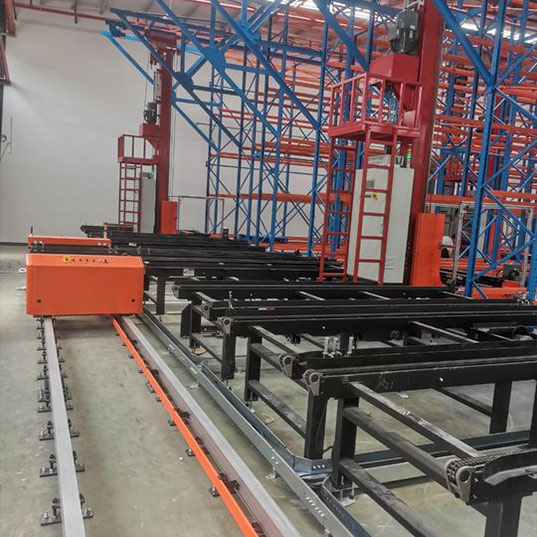
1) AS/RS: two four-way shuttle AS/RS systems, totaling 4,107 storage locations, using six 1.5-ton four-way shuttles.

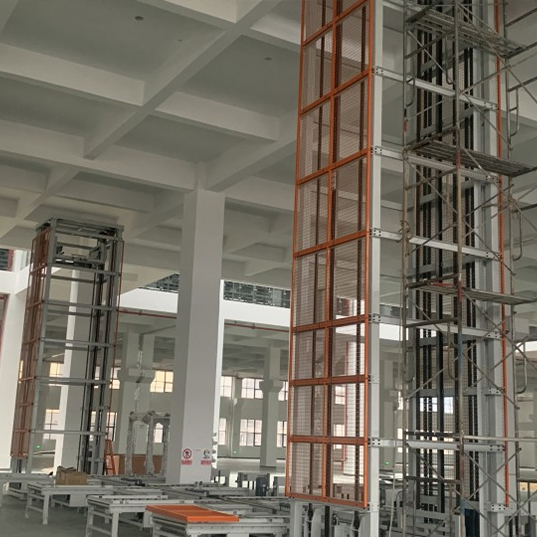
2) Pre-warehouse conveying and sorting system, equipped with four lifts, more than 60 types of conveying equipment, and four 3D vision robots.

3) Software: Warehouse Management System (WMS).


IV. Challenges of the Jinfei Wheels Project Wheels Project

In early 2020, during the initial outbreak of the pandemic, a phone call from Fuda Alloy in Wenzhou brought the two companies—already geographically close in southern Zhejiang and southern Jiangsu—into closer collaboration. During discussions, EFX learned that, driven by rapid business growth, Fuda Alloy urgently needed to build a high-standard automated AS/RS to achieve close coordination between production and warehousing and to establish an effective information-sharing mechanism across the supply chain. After confirming the project consultation requirements, EFX immediately traveled south to Wenzhou to visit Fuda Alloy. Following on-site research, although a preliminary solution plan had been formed, there was still a significant gap before detailed design and implementation. Through continuous communication with the head of Fuda Alloy’s automation division, both parties jointly identified the following four key challenges of the project.

Project Challenge 1: How copper alloy products with different specifications can be accurately sorted prior to inbound storage.

Project Challenge 2: How to improve quality, reduce costs, and enhance efficiency in highly customized smart warehousing under unstable inbound flow conditions.

Project Challenge 3: How to achieve a higher level of safe load-bearing capacity under the constraints of the civil structure of a second-floor warehouse.

Project Challenge 4: How the newly implemented warehouse management system can form a fully closed-loop integration with the existing ERP system and the newly introduced MES system.

Identifying the key problems means solving half of them, bringing the project closer to success. In response to these four challenges, EFX provided corresponding solutions.

V. How EFX Helped Jinfei Wheels Reduce Costs and Improve Efficiency

  • 3D vision sorting to create a new industry benchmark for automated warehousing projects.

    Fuda Alloy has a wide variety of products with different standards and specifications. Accordingly, shelf layer heights and load capacities vary, requiring materials to efficiently, rapidly, and accurately complete depalletizing, grasping, classification, and repalletizing operations on the conveying line before inbound storage. In this project, EFX adopted 3D vision robots. By combining three-dimensional visual imaging with digital sensing technology, the robots accurately identify products and quickly output product position, posture, and dimensions, guiding precise robotic grasping for palletizing, classification, and inbound sorting.

    Through the 3D vision robot solution provided by EFX, Fuda Alloy’s smart warehousing project has become a new local model and an industry benchmark.


    How EFX Helped Jinfei Wheels Reduce Costs and Improve Efficiency
  • Improving quality, reducing costs, and increasing efficiency through innovative four-way shuttle material conveying concepts.

    The fundamental objective of building smart warehousing for enterprises is to improve quality, reduce costs, and increase efficiency in material storage and transportation processes, and the Fuda Alloy project is no exception. In many non-standard projects, material transportation and inbound operations often follow a sequence, which can result in idle time for four-way shuttles, preventing maximum utilization of equipment. Considering project budgets, making reasonable use of four-way shuttles during idle periods—when they are not performing inbound shuttling—to undertake part of the material conveying tasks can reduce the need for at least one additional conveying line or several AGVs, thereby lowering unnecessary investment costs. This represents a flexible and practical solution.

    In the Fuda Alloy project, by adopting a four-way shuttle AS/RS, EFX extended the shuttle rails to the conveying lines, enabling the shuttles to complete part of the inbound conveying tasks during idle time, ultimately greatly improving equipment utilization. A small creative improvement fully demonstrated the effects of improving quality, reducing costs, and increasing efficiency.


  • System AI algorithms introducing a new model of dynamic weight-based location management.

    Due to limitations of the warehouse’s civil structure, storage locations and load-bearing capacity faced significant challenges. The specifications of copper alloy products (size and weight) have a substantial impact on shelf layer heights, load-bearing capacity, and layout. During stacking, some shelves may not reach full load capacity, while others may risk overload. Without resolution, neither safety nor high-density storage could be effectively ensured.

    To address this issue, EFX and Fuda Alloy held intensive discussions, revised the solution, controlled material flow, and increased storage locations. Ultimately, based on system algorithms, they established a principle of dynamic weight-based storage locations for Fuda Alloy, increasing dynamic weight allocation to resolve the actual load-bearing issues of the second-floor warehouse. This achieved two goals at once: maximizing shelf load storage while fully ensuring safety.

  • Eliminating information silos and building a fully closed-loop ecosystem for material production, transportation, and storage.

    Generally, when enterprises build digital system architectures, later-introduced systems must be compatible with previously implemented core systems to achieve mutual compatibility and efficient operation.

    EFX’s self-developed Warehouse Management System (WMS), through open interfaces, seamlessly integrated with Fuda Alloy’s existing ERP and newly introduced MES systems. This broke down information silos across different operational segments, ensuring that information from each segment is no longer isolated and enabling a fully closed-loop ecosystem with visible processes, automatic control, and intelligent management across production, conveying, and storage.

    How EFX Helped Jinfei Wheels Reduce Costs and Improve Efficiency

VI. Project Significance

One-stop efficient delivery with full accompaniment during production, facilitating rapid signing of the Phase II project.

After project delivery, the EFX team stationed on site to provide accompaniment during production. Throughout more than six months of trial operation with on-site support, the system equipment was fully debugged and operated efficiently and stably, once again validating the rationality of the earlier planning and design and successfully completing project acceptance.

Fuda Alloy highly recognized EFX for its level of cooperation, professionalism, and delivery efficiency, and promptly signed the Phase II project.


III. Successful Case | EFX Helps SCII Overcome Enterprise Project Challenges

1. Timeline

1) Cooperation time: February 2021; 2) Delivery time: October 2021.

2. Project Background

Shanghai SCII Electronics Co., Ltd. is a Sino-foreign joint venture under the U.S.-based TYCO Electronics Group. Established in March 1999, the company is located at No. 1058 Xiaoyun Road, Baoshan Industrial Park, Shanghai. It is mainly engaged in the R&D, production, and sales of filters, relays, transformers, and related products, which are primarily exported to the United States, Canada, and other regions. The company has been awarded the title of Shanghai Advanced Technology Enterprise.

3. Solution

EFX highly customized smart raw material warehousing solution: a fully automated solution covering inbound receiving, inspection, storage, and sorting for production line feeding.

4. System Equipment

1) AS/RS: one raw material automated warehouse equipped with three stacker cranes; each stacker crane has a load capacity of 500 kg, a height of 7 m, and a single-machine throughput of 45 pallets/hour (85% operating rate).

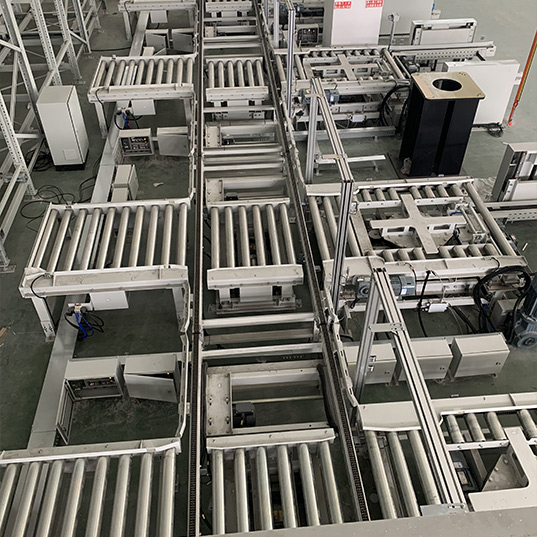
2) Pre-warehouse conveying and sorting system, equipped with chain conveyors, roller conveyors, lift-and-transfer units, sorting workstations, inbound inspection systems, and other automated conveying equipment.

3) Software: equipment monitoring and scheduling system (WCS) and warehouse management system (WMS).


IV. SCII Project Challenges Wheels Project

After fully understanding the customer’s requirements, EFX identified two major challenges in this project due to the storage of tens of thousands of SKUs and the complexity of material preparation.

Project Challenge 1: With a wide variety of incoming materials from suppliers and a relatively traditional original management approach, how can effective digital management be achieved?

Project Challenge 2: When production line material preparation often involves small quantities and many product types, how can production requirements be reliably ensured?

To effectively address the above challenges and deliver a solution that perfectly matches the customer’s actual needs, EFX dispatched professional solution planning personnel to the site at the early stage of the project to conduct in-depth and detailed communication with the customer. This included gaining a thorough understanding of each process and pain point across inbound receiving, inspection, storage, sorting, and line feeding. By analyzing the issues one by one and integrating the customer’s operating habits, suitable solutions were identified. After multiple rounds of in-depth discussions with various departments, a project solution satisfactory to the customer was delivered.


V. How EFX Helped SCII Reduce Costs and Improve Efficiency

  • Inbound material management is difficult—standardize inbound methods, implement barcode management, and achieve clear, dynamic visibility.

    Supplier inbound methods were standardized, unified coding rules were implemented with one code per item, and products suitable for pallet stacking were delivered using SCII’s dedicated AS/RS pallets. This controlled part of the inbound material forms at the source and significantly reduced palletizing work before storage. For products not suitable for direct pallet transportation, materials were scanned before inbound and stored using dedicated AS/RS palletizing solutions. All materials were managed with dedicated codes, making process dynamics clearly visible at a glance.


    How EFX Helped SCII Reduce Costs and Improve Efficiency
  • Small quantities with many varieties make outbound operations difficult—visualized sorting and dynamic picking for fast and accurate operations.

    Due to the special nature of the customer’s products, a wide variety of raw materials are required during the assembly process. To effectively meet this requirement, in addition to standard full-pallet outbound stations, EFX installed more than 20 meters of inbound and outbound diverging conveyor lines on the side of the smart warehouse and set up multiple sorting workstations. Each workstation was equipped with sorting displays and scanning devices, enabling operators to quickly and accurately pick the required materials according to on-screen instructions.

    After sorting, the remaining materials are conveyed via the diverging conveyor line and directly returned to storage through a dual-station RGV, eliminating offline forklift transfer time.


  • How EFX Helped SCII Reduce Costs and Improve Efficiency

VI. Project Significance

Customer satisfaction is always our ultimate goal!

The smart raw material warehouse of Shanghai SCII Electronics Co., Ltd. is another representative case of EFX’s successful collaboration with end customers.

Since its delivery in 2021, the equipment has been running stably, providing reliable production and delivery support for the client’s rapid growth, while both parties continue to maintain a friendly and cooperative relationship.


联系我们
联系我们
浏览至顶浏览至顶 联系销售Contact